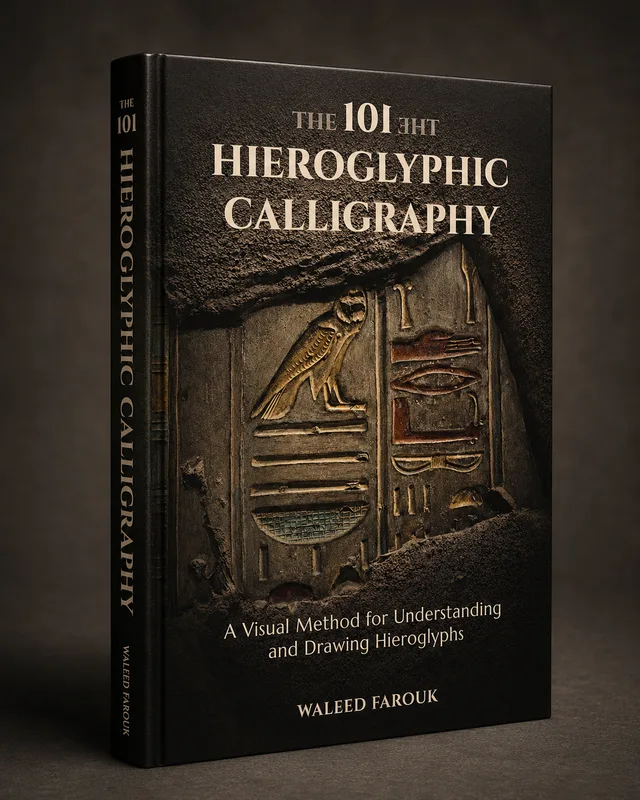
The 101 Hieroglyphic Calligraphy
Most books about hieroglyphs begin with reading. This book begins with seeing.
Learn to See, Understand, and Draw Ancient Egyptian Hieroglyphs
Download the free 20-page sample and learn how the Egyptian Vulture, G1, is built through six guided strokes using the MDW Method: Measure · Draw · Write.
No prior knowledge of Egyptology, Middle Egyptian, drawing, or calligraphy is required.
English digital edition planned for September 2026.
Get the Free SampleFree PDF · Sent by email · Includes thoughtful launch updates · Unsubscribe anytime
Free 20-page sample
G1 in six guided strokes
Beginner-friendly
Releasing September 2026
Complete Your First Hieroglyphic Sign
The free sample is a guided first experience, not a collection of disconnected preview pages. It takes you from the atmosphere of ancient Egypt into the visual logic of hieroglyphic writing, then lets you build G1—the Egyptian Vulture—through all six strokes.
Inside the sample, you will:
- Enter the story through an opening from In Lost Times...
- Learn how the faces of signs reveal the direction of reading.
- See how mirrored hieroglyphic compositions work in architectural space.
- Understand the MDW Method: Measure · Draw · Write.
- Complete G1, the Egyptian Vulture, stroke by stroke.
You will not only read about the method. You will use it and finish your first complete sign.
Send Me the Free SampleThis Book Begins With Seeing
Most books about hieroglyphs begin with reading. This book begins with seeing.
Grammar, translation, and sign lists are essential. This book keeps that foundation in view, but opens another entrance: the visual path.
Hieroglyphs are approached as forms to study, understand, and draw with care. You learn how a sign occupies space, gathers balance, carries direction, and becomes clearer when the eye, the mind, and the hand work together.
Rather than copying a complex outline by instinct, you learn the visual logic behind the form. What first appears difficult becomes a sequence. What first feels distant becomes something you can build.
This is not passive admiration. It is knowledge becoming practice.
Measure · Draw · Write
The MDW Method turns a difficult image into a sequence of clear decisions.
Measure
Place the sign inside the quadrat—a measured field that controls proportion, balance, and position.
Draw
Follow the strokes in a clear order, guided by numbered movements and the repeating red, green, and blue sequence.
Write
Complete the form as a written sign, not as a picture copied by guesswork.
You do not guess the sign. You build it—stroke by stroke.
Inside the Full Book
The book is designed as one connected journey: from the story and structure of Egyptian writing to disciplined practice, a complete sign set, and the personal act of composing your own name.
The Tale
Follow the story of Egyptian writing from its earliest traces through its long development, silence, and rediscovery.
The Pillars
Learn how signs carry sound and meaning, how direction works, and how hieroglyphs are composed inside balanced quadrats.
Initiation
Explore the discipline, balance, and contemplative attention surrounding the scribe’s craft, with historical, reflective, and interpretive layers clearly distinguished.
The 31-Sign Set
Study a focused set of 31 signs through a consistent four-page journey: the sign introduction, guided drawing pages, and the completed form.
Hearing the Signs
Use QR codes to hear the conventional readings used by Egyptologists today—presented honestly as a learning aid, not as recovered ancient speech.
Practice and Say Your Name
Train with a printable practice sheet for every sign, then use five clear moves—Pronounce · Puzzle · Construct · Draw · Encircle—to compose your own name inside a cartouche as a respectful modern adaptation.
The English edition will launch digital-first in September 2026. A Kindle edition is planned to follow, and the premium print edition will be announced separately.
Who This Book Is For
You do not need to arrive as an expert. You need curiosity, patience, and a willingness to look closely.
The Curious Egypt Explorer
For readers drawn to ancient Egypt, museums, temples, objects, symbols, and the feeling that the past still has something to say. The book offers a more active way to come closer: not only by reading about the signs, but by learning how their forms are built.
The Creative Visual Practitioner
For artists, designers, calligraphers, illustrators, tattoo artists, makers, and visually minded learners who care about form, rhythm, balance, and symbolic beauty. The signs become forms to study, understand, and draw with control.
The Reflective Symbol Seeker
For readers drawn to meaning, contemplation, sacred writing traditions, and the quiet discipline of art. The book leaves room for deeper encounter while keeping its historical and linguistic material grounded.
Also valuable for Egyptology students, educators, families, and dedicated learners who want greater confidence in forming hieroglyphic signs.
Join the September Launch List
Receive the free 20-page sample now, then get thoughtful behind-the-book updates and first notice when the English digital edition is released.
Frequently Asked Questions
Is this book beginner-friendly, and do I need prior knowledge?
Yes. No prior knowledge of Middle Egyptian, Egyptology, drawing, or calligraphy is required. The book introduces the essential ideas clearly and guides you from understanding the script to drawing the signs step by step.
Is this book about reading hieroglyphs or drawing them?
Both, but its distinctive focus is hieroglyphic calligraphy. You first learn the story, sound system, reading direction, grouping, and visual structure of Egyptian writing, then use that understanding to draw and write the signs with clarity and accuracy. It is not intended to replace a complete grammar course.
What makes the MDW Method different?
MDW means Measure · Draw · Write. You first place the sign inside a measured quadrat, then follow its strokes in sequence, and finally complete it as a written sign. The method replaces guesswork with position, order, and repeatable practice.
What does “101” mean, and how many signs are taught?
“101” means an introductory first course and the opening volume in a planned learning series; it does not refer to the number of signs. This book teaches a carefully selected set of 31 signs: 24 core uniliterals, useful alternative forms, two forms of y, and two additional signs used to support writing modern names.
Is this a spiritual or academic book?
It is neither a conventional academic manual nor a purely spiritual book. Its historical, linguistic, and Egyptological material remains grounded, while selected sections offer a clearly identified contemplative and interpretive dimension.
What will I receive when I join the launch list?
You will receive the free 20-page sample, including an opening from the book, lessons on reading direction and mirroring, an introduction to the MDW Method, and the complete six-stroke drawing journey for G1, the Egyptian Vulture. You will also receive thoughtful book updates and first notice when the book is released.
Are practice sheets and pronunciation support included?
Yes. A printable practice booklet with one dedicated sheet for every sign is included. Each sign page also carries a QR code for the conventional reading used by Egyptologists today. This is a practical learning aid, not a claim to reproduce the exact ancient pronunciation.
When will the book be released, and will it be digital or printed?
The English direct digital edition is planned for September 2026. A Kindle edition is planned to follow. A premium print edition is also planned, with its availability and timing to be announced separately.
Will there be an Arabic edition?
Yes. The first edition will be in English. The Arabic edition is planned to follow approximately 2–3 months after the English release.
Do I need special tools to practice?
No. You can begin with an ordinary pencil or pen and the printable practice sheets. A tablet or digital drawing tool is optional. Careful observation and steady repetition matter more than expensive equipment.
Begin With One Sign
The journey does not begin with memorizing hundreds of symbols. It begins by learning to see one form clearly—and building it with your own hand.
Download the free sample and complete G1, the Egyptian Vulture, in six guided strokes.
English digital edition planned for September 2026.
Get the Free Sample